Micro Community
The Affordable Housing Project (Coming Soon)
Overview
This micro-community residential project explores a new approach to small-scale housing development in New Zealand. By combining compact home design, shared green spaces, and efficient site planning, it aims to deliver more affordable and liveable housing options.
The Concept
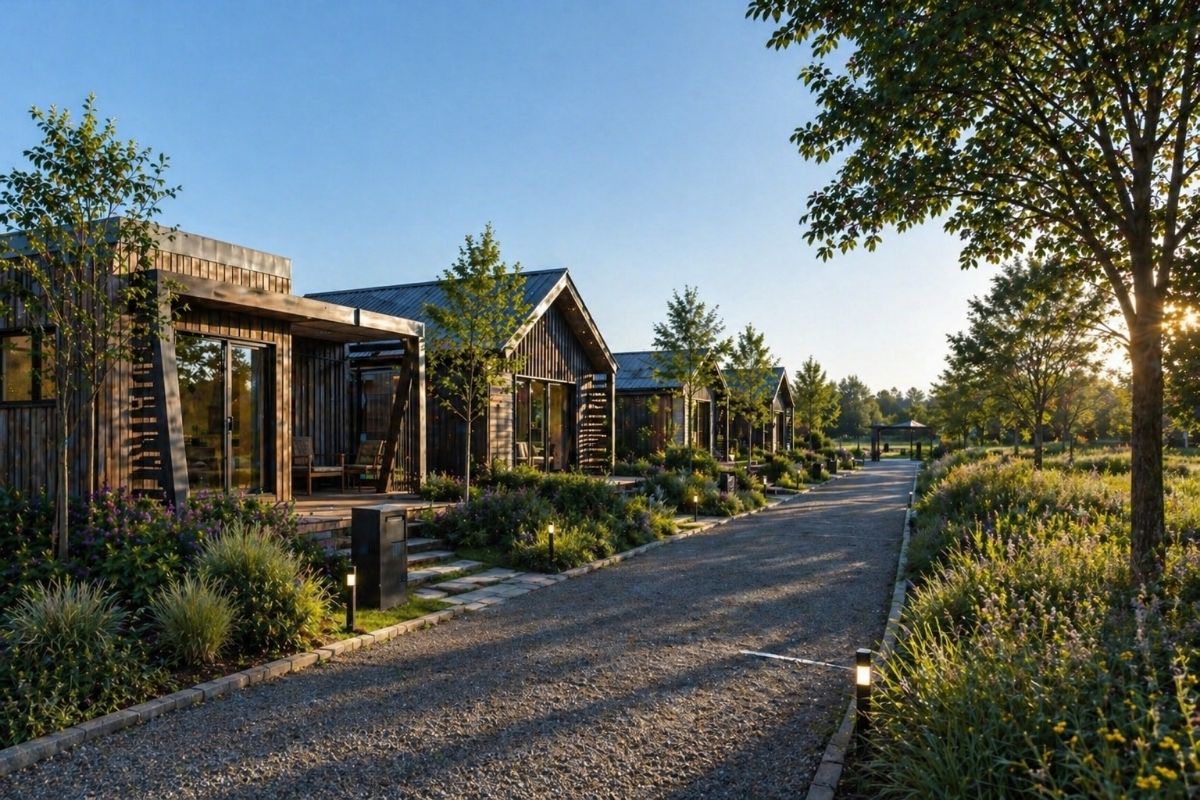
Instead of large individual sections, this approach clusters a small number of homes around a shared green space, with each home also having its own private outdoor living area.
The result is a balance of connection and privacy — shared space when you want it, and your own space when you don’t.
This allows:
a balance between privacy and connection
efficient use of land without feeling crowded
smaller, better-designed homes instead of oversized dwellings
shared spaces that are usable, not leftover
This avoids:
large, underutilised private sections
inefficient layouts that prioritise size over function
isolated homes with no sense of community
leftover or unusable outdoor spaces created by poor site planning
Indicative Site Approach
Site size: approx. 2,500 – 4,000 sqm
Typically rural residential or edge-of-urban locations
Focusing on sites without major planning constraints or environmental limitations.
Similar to how retirement communities are structured, with individual homes and private outdoor areas, supported by shared spaces managed collectively.
Typical Community Layout
Approx. 8–12 homes per site
Homes arranged around a shared central green space
Simple access and infrastructure layout
This creates a balance between:
individual ownership
and shared amenity
Housing Mix
A mix of smaller and family-sized homes allows for a wider range of occupants:
1-bedroom homes (~30–40sqm)
2-bedroom homes (~60–75sqm)
3-bedroom homes (~80–100sqm)
4-bedroom homes (~100–120sqm)
This supports:
singles and couples
young families
downsizers
multi-generational living
Design Approach
The homes are designed using compact planning principles:
efficient layouts with minimal wasted space
shared or overlapping functions where appropriatesimple
building forms to reduce construction cost
indoor-outdoor connection
The focus is not on making homes smaller —
but on making them work better.
Affordability Strategy
Affordability is achieved through a combination of:
reduced land cost per dwelling
smaller, more efficient homes
simplified construction methods
shared infrastructure and outdoor space
Rather than lowering quality, the aim is to optimise where space and cost are used.
Delivery Pathway (In Progress)
This project is currently exploring multiple delivery approaches, including:
small-scale development partnerships
prefabricated or modular construction systems
staged build or pilot projects
alternative ownership or co-ownership models
The exact pathway will depend on site, partnerships, and feasibility.
Current Status
Concept and layout development underway
Site opportunities being assessed
Feasibility and delivery models in progress
The Goal
To deliver a replicable model for housing that is:
affordable
practical to build
adaptable to different sites
and genuinely aligned with how people live
Interested in being involved?
Are you:
A landowner?
A potential partner?
Or an early buyer?